Your market is already telling you what to publish next.
SignalSifter watches the places your customers actually talk. When a conversation starts moving in a way that matters to your business, it tells you what happened, why it matters, and then writes the content to go with it.
Thirty minutes. We point SignalSifter at your market and look at what comes back, live, while you watch.
Currently watching
- YouTube
- Hacker News
- RSS & Atom
- News & blogs
- Shared links
Plus any link shared along the way. New sources added continuously.
By the time a trend shows up in a report,
the conversation has moved on without you.
You find out late
The post you could have published Tuesday goes out Friday, after three other people have already said it better. Timing is most of what makes a piece of content work, and it's the part nobody is measuring.
You're guessing
Topics come out of a planning meeting. Nobody in that meeting has read the thread where four hundred of your customers are arguing about the exact problem your product solves.
The tools stop short
Social listening reports volume. Alerts report that a keyword appeared. Neither one tells you whether it matters or what to do about it, so somebody on your team still has to go read everything.
One outage thread, from first comment to finished post.
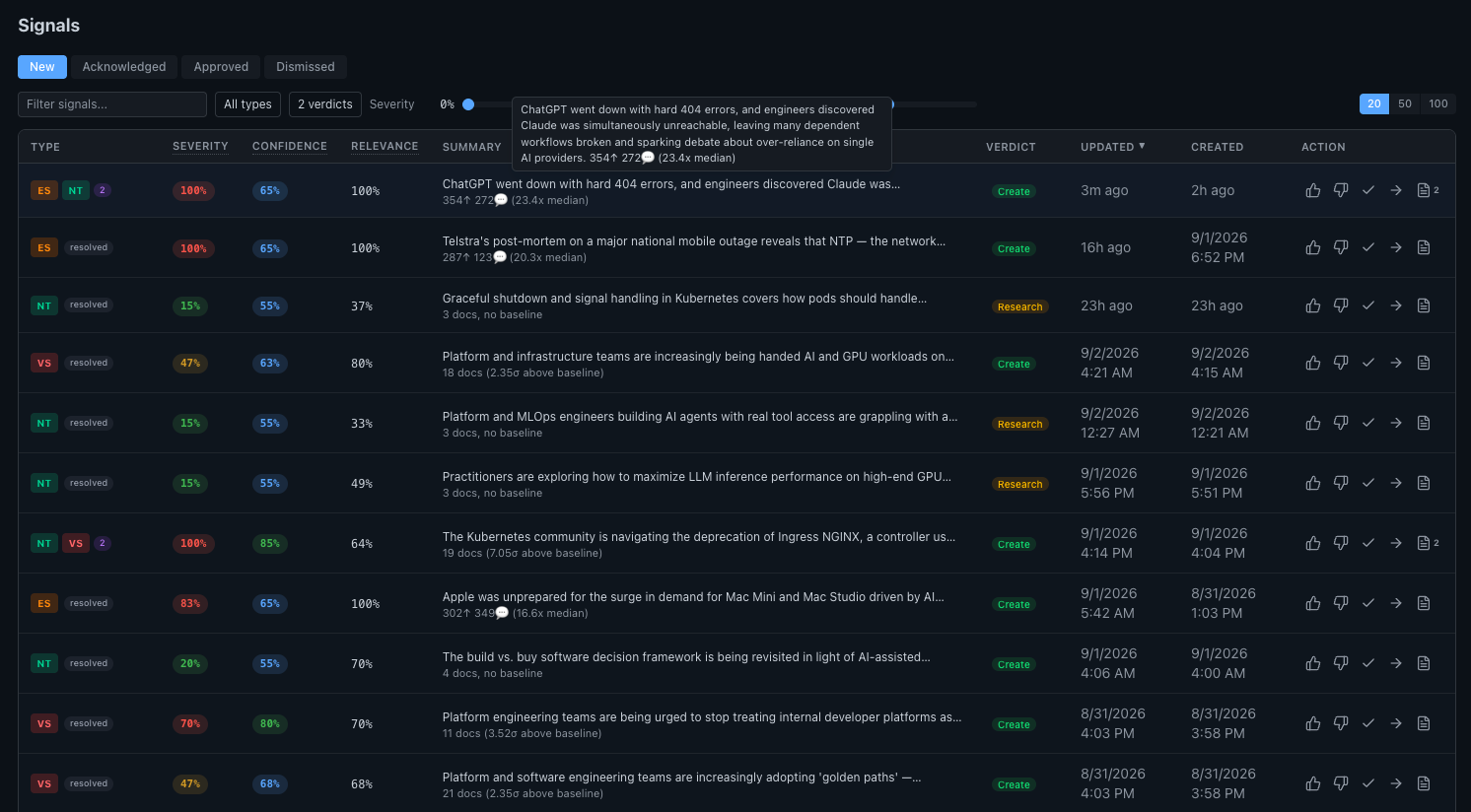
SignalSifter noticed it before it was news
Comment velocity on the thread hit 23 times the median rate for that source, and the engine flagged it within minutes of the thread starting. No keyword had to be configured and nobody had to know an outage was happening. Two hours later it was on its 24th refresh, still tracking, because the conversation was still growing.
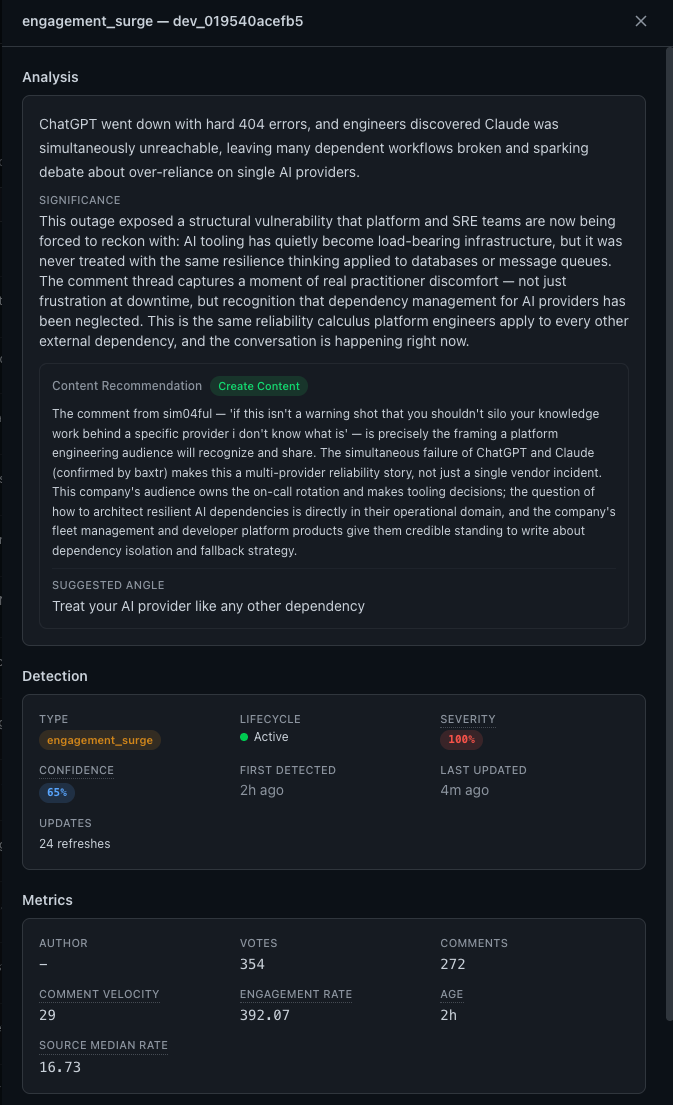
SignalSifter read it
Not a keyword match and not a summary of the thread. The analysis works out what the conversation reveals, who is having it, and why this particular moment is unusual.
"This outage exposed a structural vulnerability that platform and SRE teams are now being forced to reckon with: AI tooling has quietly become load-bearing infrastructure, but it was never treated with the same resilience thinking applied to databases or message queues." Significance, generated
Underneath it, the receipts: severity, confidence, how long the signal has been live, how many times it has been refreshed, and the raw engagement numbers it was measured against.
SignalSifter turned it into an angle
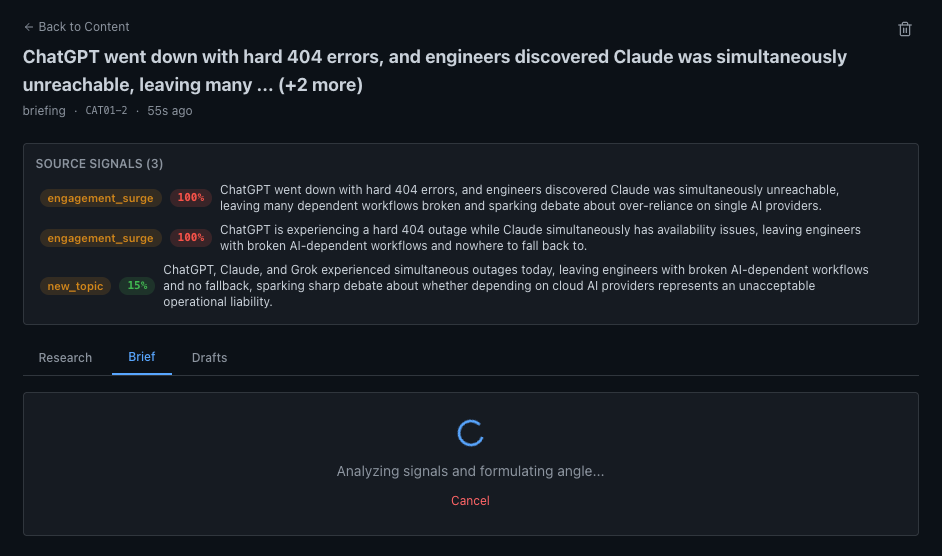
The verdict came back create content, with an angle attached:
Treat your AI provider like any other dependency.
The recommendation quotes the comment that frames the story, points out that this company's audience owns the on-call rotation, and names the two products that give them standing to write about dependency isolation. Three related signals were merged into one briefing so the same story doesn't get written three times.
SignalSifter wrote it
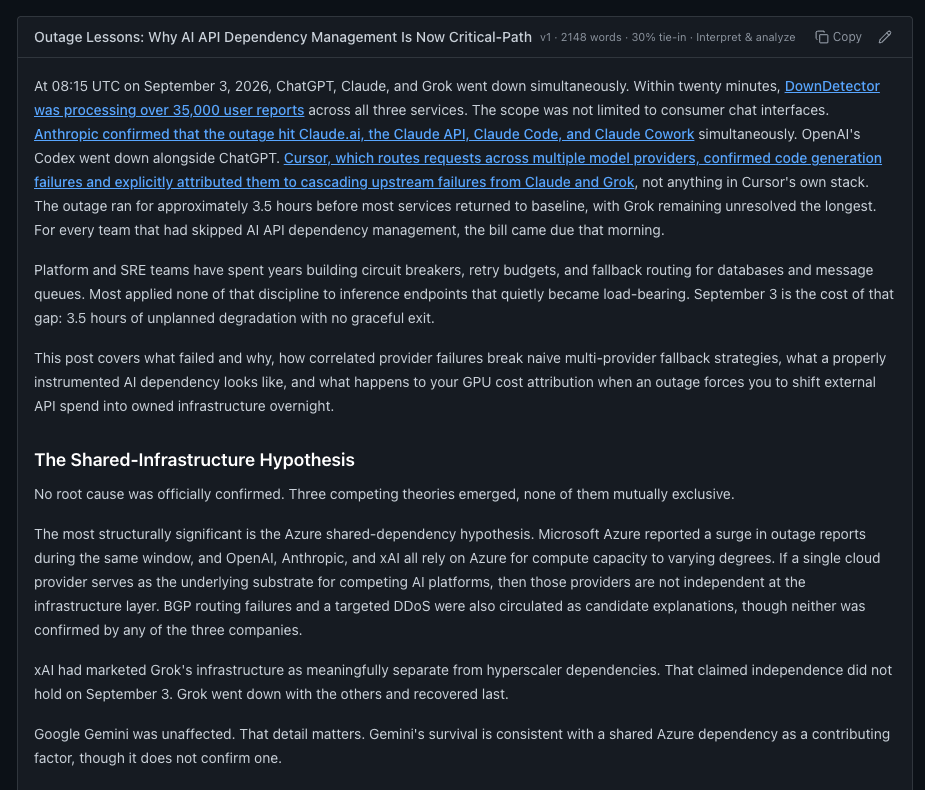
2,148 words, opening on the timestamped facts and linking out to DownDetector, Anthropic, and Cursor as primary sources. The header tracks how much of the piece ties back to the company's own products, so the tie-in is a number you can see rather than a thing you hope for. Detected in minutes, researched, and written while the thread was still growing, on an angle nobody in a planning meeting would have found.
continues for another 1,700 words
Curious what's moving in your market right now?
Book a discovery call. We point SignalSifter at your market and look at what comes back, live, while you watch.
What it's doing while you're not looking.
Watch
It reads continuously from forums, video, feeds, news sites, and anything linked out of those places. Video gets transcribed, so a claim buried forty minutes into a stream is as findable as a headline.
Detect
Everything is measured against what normal looks like for that source and that topic. Normal is boring, so normal gets ignored. When activity, sentiment, or the cast of characters pulls away from the baseline, that's a signal.
Write
Each signal is read against your business: what it means, which angle is yours to take, and what to do about it. Verdicts come back as create, research, or skip, and on a create it writes the piece in your voice.
35+
pieces available each day
A tuned account surfaces five to ten strong signals a day, and each one can carry several different pieces. Nobody publishes all of that, and it isn't meant to be a quota. The point is that every day there is something ready to go that ties directly to what your market is talking about right now.
No single measure decides anything. How much people are saying, how hard they're engaging, the tone of it, whether the topic is new, who is doing the talking, and how far it has traveled are all scored separately, by different methods, against your market rather than the internet at large. A signal only surfaces when enough of those agree that something changed. That's why it stays quiet most of the time, and why it's right when it doesn't.
What happens when you know what content to create.
2,000
upvotes on a first-ever Reddit post
Thirteen times the best post that community had ever seen, from an account with no prior presence there. A separate idea the engine surfaced went on to add 4,500 subscribers and 125,000 views on YouTube in two and a half months.
0 → 20,000
subscribers in under a year
Built from nothing, with no existing audience and no paid promotion. The videos are still pulling views nine months after the channel stopped posting, because the topics were picked for durability rather than for the week they went up.
3 weeks
holding page one of Google
The founder published a LinkedIn post on an angle the system surfaced. It reached the front page of Google within hours of going up and stayed there for three weeks.
Results like these and more are possible if the fit is there. Book a discovery call, and let's talk.
This started as a tool I built for my own show.
In 2020 I was running a live stream five days a week called Coffee and Cloud Native. The hard part was never the demo. It was deciding what to demo. I built something that pulled the Twitter firehose, filtered it through ML models tuned for the devops and Kubernetes tooling space, and handed me a report every morning: fifteen or twenty things people were genuinely talking about that day.
I'd pick three to five, test them that afternoon, and demo them on the stream the next morning. It ran that way for six months and the audience loved it, mostly because I was never guessing about what they wanted to see.
That was two years before ChatGPT. I've been doing AI and ML work since 2017, and I've kept some version of this running on my own content and businesses ever since. SignalSifter is that tool, rebuilt properly, opened up so other people can get the same results out of it.

Adrian Goins
Founder, Wynnett
Who this is built for.
✓ A good fit
- ✓ You publish regularly and the hard part is deciding what to publish.
- ✓ Your customers argue about your category in public: forums, comment sections, video, feeds.
- ✓ You need more output than the people you have can produce.
- ✓ Someone on your team already spends hours a week reading just to stay current.
- ✓ Being early to a conversation makes real money in your market.
× Not a fit
- × You need a scheduler or an editorial calendar. SignalSifter decides what to publish, not when to post it.
- × Your market doesn't discuss your category in public. SignalSifter reads conversations, so it needs conversations to read.
- × You're shopping for a cheap alerts subscription. SignalSifter does the work of an entire content team at a fraction of the price.
- × You publish once or twice a month. SignalSifter produces more in a day than you'd have any use for.
What people want to know.
If you have a question that's not here, book a discovery call and let's see if it's a fit.
How is this different from social listening or keyword alerts?
Those tell you a keyword appeared and roughly how often, which leaves you holding a reading list. SignalSifter measures against a baseline, so it only speaks up when something has changed, and what it hands back is the analysis, the angle, and the finished piece.
How long before I see anything useful?
Signals start showing up within minutes. Dialing them in takes about a week of active use: you vote signals up and down, and it learns what matters inside your domain.
How much setup is involved?
30 to 60 minutes, and you can do it yourself: your company, your products, your competitors, and the sources you care about. If you want to be up and running in the shortest possible time, onboarding with us is the shortcut.
Does it write the content too?
Yes. Finished, publishable pieces on the angle it found, in your voice. It replaces a content team rather than feeding one. Most people still put their own hands on a piece before it goes out, the same way they would with any writer on staff.
Do I need to be technical to use it?
No. If you can read a dashboard and judge whether an angle is right for your brand, you can run it.
What does it cost?
It depends on how much of your market you want covered, so we price it on the call. It does the work of an entire content team at a fraction of the price.
Find out whether we can help you.
Thirty minutes. You'll leave knowing something about your market you didn't know going in.
- 1 You tell us what you sell and who you're trying to reach.
- 2 We point SignalSifter at your market and look at what comes back, live, on the call.
- 3 You see the real signals from your market, and the content it would write about them.